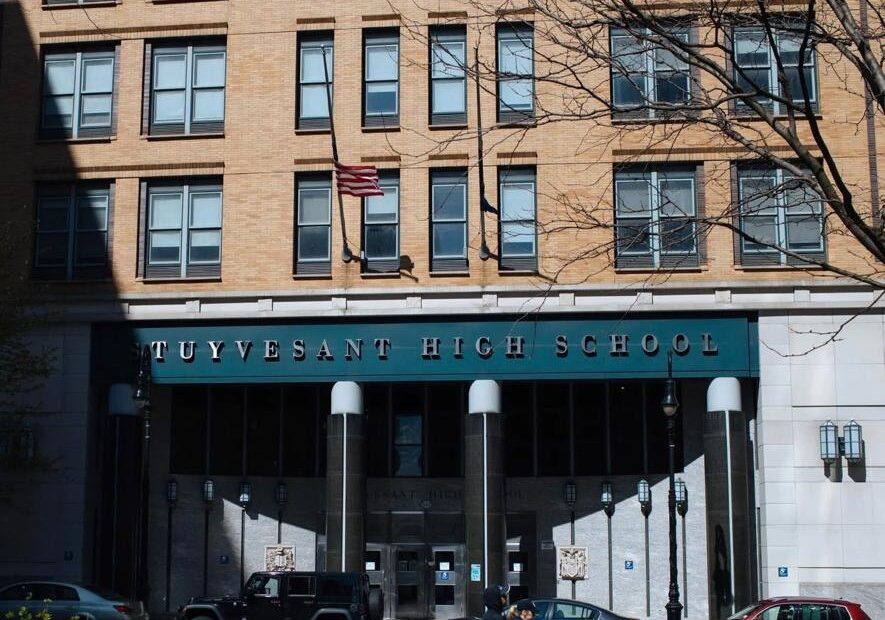
| Top Stories The Test Debate An Elite N.Y.C. Public School Admitted 777 Students. Only 3 Were Black. NY Times, 7/14/2026 A disproportionately small number of Black and Hispanic students received admission offers to New York City’s elite public high schools for the upcoming academic year, continuing a pattern of racial and ethnic gaps that has existed for years despite promises by elected officials to address the divide. About 62 percent of the students in the city’s public schools are Black or Hispanic. But at its eight most prestigious high schools, about 10 percent of the students in the incoming freshman class are expected to be Black or Hispanic, roughly the same as last year. About 80 percent of the seats went to Asian and white students. Yiatin Chu, a public school parent and the co-founder of Parent Leaders for Accelerated Curriculum and Education, a group that has supported gifted and talented programs, said that the entrance exam was a “race-blind, income-blind test.” …“These schools are rigorous and demanding, and students who go to these schools should be well-prepared to take that on,” Ms. Chu said. “Why are we minimizing the effort that is put in for something that is important to them?” “Too Many Asians” Boot camp to improve diversity at elite NYC schools also lacks diversity, data shows Gothamist, 7/16/2026 A summer prep program meant to improve racial diversity at the city’s elite specialized high schools is itself lacking, data from the education department shows. …Data shows Asian students make up 62% of students in Discovery, but 19% of the entire system. Latinos make up 16% of students in Discovery, but 42% of the overall system. Similar disparities exist for white students (7.4% in Discovery, 16% overall) and Black students (11% in Discovery, 19% overall). In an effort to expand access and address racial disparities, then-Mayor Bill de Blasio expanded Discovery in 2018 so that 20% of seats at the specialized schools are set aside for students, regardless of race, who meet a threshold for economic need and complete the program. Reform to the Discovery program was a “helpful additive, but not transformative,” de Blasio said in an interview. “Hearing those numbers is painful,” he said of the recent admissions data. “I still say the status quo is unacceptable.” What Next? Most high schoolers no longer need to pass Regents to graduate. Schools are in the dark on what’s next Chalkbeat, 6/23/2026 By next fall, the majority of students in New York high schools will not be required to pass the state’s Regents exams to earn a diploma, a major shift that state officials hope will reshape teaching and learning. There’s just one problem: The state Education Department has not yet revealed what the new graduation requirements will look like — even as the Class of 2027 will be the last cohort that must pass the exams to graduate under the current timeline. That disconnect is alarming advocates and educators who worry that schools will not have enough time to seamlessly transition to new graduation standards. Advocacy Corner |
NEW PODCAST EPISODES And…That’s a Wrap PLACE NYC, 6/25/2026 Kicking the Can PLACE NYC, 6/18/2026 Missed an episode? Check out Season 1 here. Other Headlines Schools Chancellor Kamar Samuels is looking good NY Daily News, op-ed by Lincoln Restler, 7/18/2026 Pssst…It’s Not The Test A Test Isn’t Racist. Assumptions About Black Kids Can Be. NY Times, op-ed by John McWhorter, 7/16/2026 It has become a summer rite to bemoan how few Black students are admitted to Stuyvesant and other highly competitive public high schools in New York City. And the numbers are unpleasant. This year only three of 777 students admitted to Stuyvesant are Black. Last year it was eight out of 781. Since about one in five public school students in New York City is Black, many see the paucity of Black students at what are called specialized high schools as evidence that their admission standards must be unfair. “There needs to be a real, independent investigation into the admissions process,” the Queens borough president, Donovan Richards Jr., said after the latest results were released. Many have demanded the elimination of the Specialized High School Admissions Test — the sole measure of whether a student will be admitted (except at the LaGuardia performing arts school, which uses an audition process). Is the problem the test, or what happens before the test? Fix the Broken Pipeline NYC should fix its broken pipeline, not break its best schools Washington Examiner, op-ed by Daniel Idfresne, 7/16/2026 The New York Times, Gothamist, and other publications have once again insinuated that Brooklyn Tech and its sister specialized high schools are discriminatory. “An Elite N.Y.C. Public School Admitted 777 Students. Only 3 Were Black,” the New York Times headline read. Chalkbeat reported, “Just 1 Black student gets into Staten Island Tech as racial gaps at specialized high schools persist.” I attended Brooklyn Tech, and the headlines are misleading. Reports about the vanishing black and Hispanic populations at specialized high schools conjure images of wealthy white students parading through their halls. Far from it. Florida student’s historic 11.99 GPA before district policy overhaul NY Post, 7/14/2026 Recycled SHSAT Attack What Lincoln Restler Gets Wrong About New York’s Specialized High Schools City Journal, by Wai Wah Chin, 7/14/2026 On Saturday, New York City councilmember Lincoln Restler took to X to attack the latest admissions figures for Stuyvesant High School. …When most of city schools are underperforming, some legislators prefer deflection. Rather than address the far greater problem—the vast majority of schools failing to educate their predominantly black and Hispanic students—Restler went after the admissions process for eight high-performing specialized high schools accounting for only 1.5 percent–2 percent of city students. UC abruptly suspends timeline to reconsider SAT in admissions LA Times, 7/13/2026 NYC specialized high schools continue to offer few seats to Black and Hispanic students NY Daily News, 7/10/2026 Just 1 Black student gets into Staten Island Tech as racial gaps at specialized high schools persist Chalkbeat, 7/10/2026 New Financial Aid Change Under a new federal rule, colleges must leave grads better off or lose financial aid NPR, 7/9/2026 This month, the U.S. Department of Education began rolling out a new accountability test that most colleges and universities will soon have to pass. The test itself is simple: If an undergraduate program’s graduates don’t earn more than workers who never went to college, that program could be cut off from federal student loans. The same goes for any graduate program whose graduates earn less than someone with only a bachelor’s degree. Fraud defines the public school system in New York City and the entire state NY Post, 7/9/2026 Do NYC schools need a redistribution of PTA wealth? Gothamist, 7/9/2026 Inflection Point? The End of Reading Is Here The Atlantic, 7/8/2026 …Some 2,000 years later, under very different circumstances, the darkness is gathering again. Americans, once members of a proudly literate society, read much less than they used to. According to the National Endowment for the Arts, which conducts the most comprehensive survey of the nation’s reading habits, fewer than half of all adults reported having read a book of any kind in 2022. Only 38 percent read a novel or short story. A study analyzing 236,000 responses to the American Time Use Survey found that the proportion of Americans who read for pleasure on any given day fell from 28 percent in 2004 to 16 percent in 2023. (The study looked at people who had read a book, magazine, or newspaper; listened to an audiobook; or read an e-book.) The decline in reading cuts across age groups, gender, and education levels. Even the demographics that traditionally read the most—retirees, women, and college graduates—have seen a collapse. NYC public schools puts technology purchases on hold amid heated debate over AI policy NY Daily News, 7/8/2026 The Failing Status Quo Staggering 900 NYC public schools failing students amid grade inflation, lax accountability NY Post, 7/7/2026 Welcome to New York’s flunking factories. Failure in the city’s public education system has become “normalized” — and even bolstered by grade inflation and fixing — with nearly half of schools consistently failing their students, a bombshell new report found. The sweeping analysis, conducted by the Success Academy Charter Schools network, found that in those 906 public schools, fewer than half of students passed math, reading, or both, on state exams last year. NYC school bosses changed F grade in AP class, then targeted teacher who exposed the scheme: lawsuit NY Post, 7/6/2026 NYC student OMNY card pilot at select schools Chalkbeat, 7/6/2026 Ignoring the Warning Signs A Great University Undermines Its Mission NY Times Editorial, 7/6/2026 Seven years ago, the University of California system appointed an 18-member committee to study the use of standardized tests in its undergraduate admissions. The committee included professors from all 10 campuses and a range of disciplines. They spent a year studying the issue and published a 225-page report full of evidence and recommendations. The committee concluded that scores on the SAT and ACT, the main standardized tests for college admissions, did a better job measuring student readiness for college than high school grades. High test scores were particularly good at finding talented students from low-income families and underrepresented minority groups. For these reasons, the committee recommended the system continue to require applicants to submit SAT or ACT scores. The university’s leaders disregarded the report. Debate at Washington Heights school highlights difficult class size tradeoffs Gothamist, 7/6/2026 ‘Mo Money, Less Students Mamdani quietly adds $700M to NYC public schools’ already bloated budget NY Post, 7/6/2026 The Big Apple’s beleaguered Department of Education quietly got even more money in this year’s massive $126 billion budget — pushing public school funding to nearly a third of all planned city spending. City documents show the DOE got $680 million more for its fiscal year 2027 budget than what Mayor Zohran Mamdani originally proposed earlier this year. That brings the DOE’s budget to an eye-watering $38.6 billion — an increase of almost $4 billion from last year, according to docs released without fanfare detailing the city’s adopted spending plan. Cambridge made all eighth-graders take algebra. The first year was a struggle. Boston Globe, 7/6/2026 Math Declines Faster solutions, lower test scores: How AI is eroding math skills Hechinger Report, 7/6/2026 When ChatGPT arrived in late 2022, educators quickly asked whether students would use artificial intelligence to cheat, learn or simply get through homework more efficiently. Evidence is beginning to point toward a troubling answer: Many students appear to be completing assignments faster while learning less from them. This conclusion comes from one of the largest studies of how generative AI is changing student behavior and academic skills. City Council demands probe of woke NYC school where students performed anti-cop dance NY Post, 6/27/2026 A new school in Brooklyn will teach about gender as Trump guts LGBTQ youth rights NY Daily News, 6/27/2026 Why Everyone Should Care About NYC Public School Education One City Rising, op-ed by Lucas Liu, 6/26/2026 Doubling Down on “Inquiry-based” Math ‘Math Wars’: New York Wants to Reform Math Instruction, but Experts Disagree on How NY Focus, 6/25/2026 New York school districts will soon begin revamping math instruction under a new law aimed at improving test scores — but the effort comes amid sharp debate over how math should be taught. …On one side of the so-called “math wars” are advocates of more explicit, teacher-led instruction who argue that students should first build fluency in foundational skills — such as memorizing multiplication tables or working through a math problem step by step — before they can understand deeper concepts. On the other are proponents of inquiry-based instruction, which emphasizes student problem-solving and exploration of mathematical ideas before formal procedures are introduced. Many New York schools use curricula that align with the latter. But critics, including special education researchers, say it can reduce student confidence, hinder learning of foundational skills, and cause struggling students to fall further behind. AI Can’t Fix the Student-Motivation Problem: It turns out bots aren’t great teachers. The Atlantic, 6/25/2026 A Democrat-on-Democrat Showdown Is Erupting Over Chicago’s Schools Wall Street Journal, 6/25/2026 NYC Public Schools delays release of AI ‘playbook’ to guide classroom use NY Daily News, 6/24/2026 China’s Math Test Can You Pass the Test That Strikes Fear Into China’s High-Schoolers? Wall Street Journal, 6/22/2026 Every June, millions of Chinese high schoolers take a make-or-break university entrance exam that many regard as the world’s hardest. The pressure is enormous. Students spend years studying everything from math to the sciences and philosophy for the “Gaokao.” A single score serves as a potential arbiter of a student’s future, determining not just whether they can attend college but also where they’ll go and what they’ll study. …Here are some of the questions that appeared this year: Mamdani eyeing chancellor replacements for scandal-plagued Samuels NY Post, 6/22/2026 The Forever Funding Faucet NYC’s $1.9 billion dilemma: How long can schools be ‘held harmless’ for enrollment losses? Chalkbeat, 6/22/2026 New York City is spending nearly $290 million next year to prevent budget cuts at schools that have lost or are projected to lose enrollment, according to new Education Department data. It’s more than double what the city spent prior to the beginning of the 2025-26 school year on the policy known as “hold harmless.” The sum reflects the increasing cost of continuing the policy that began during the COVID pandemic to provide financial stability to schools losing enrollment. Six years later, those enrollment losses show no signs of abating, and the cost of propping up budgets at shrinking schools has grown dramatically. The Parent Uprising Against Screen Time at School The Wall Street Journal, 6/21/2026 Staggering number of Berkeley Law students claim they’re disabled as ‘emotional disorders’ skyrocket NY Post, 6/19/2026 Hochul’s decision on federal school choice program should be just the first step Times Union, op-ed by Dean McGee, 6/18/2026 Pervasive AI Cheating Student Cheating Is Becoming Impossible to Detect in an A.I. Era NY Times, 6/18/2026 The videos are all over social media, making students an irresistible offer: Go ahead and let A.I. do your homework — with the latest technology, you won’t get caught. If you hate writing, you can avoid it. …These kinds of tutorials are now pervasive on TikTok and YouTube. They show students how to use tools known as humanizers and autotypers, which make it easier than ever to cheat. The videos — sometimes labeled ads, sometimes not — target college and high school students. Allegations against Kamar Samuels highlight widespread dysfunction in NYC’s school contract system Chalkbeat, 6/18/2026 The real problem with “gifted” education Slow Boring, 6/17/2026 The Contracting Scandal Facing New York City Schools City Journal, 6/16/2026 G&T Closing the Gaps How a Gifted Program Impacts Disadvantaged Students Education Next, 6/16/2026 Underlying these debates are fundamental questions about the impacts of gifted services. Could gifted programs address, rather than amplify, these gaps? When disadvantaged students are identified for gifted services, do they benefit from participation? Which students benefit the most? …The comparison around the IQ cutoff reveals the pattern previewed above: Gifted participation boosts disadvantaged students’ on-time high school graduation and college enrollment, with boys experiencing the largest gains. Some 74 percent of gifted disadvantaged boys enroll in college within one year of high school graduation compared to 46 percent of their peers who tested just below the program eligibility cutoff… Trump Breaks Up Education Dept., Prompting Worries Over Civil Rights NY Times, 6/16/2026 How family work arrangements have changed over time Pew Research Center, 6/16/2026 See how academic freedom is changing around the world Scientific American, 6/16/2026 |